


Two very special films follow from a very special and talented British film maker. One depicts a man losing his mind. The other, a mind losing it's man. Two utterly brilliant films. I hope you enjoy my "take" on them.
It is not my intention to provide huge spoilers for the coming two films. Rather, my purpose is to give a flavour for the films as I do not want to spoil these great films for you in any way. Moreover, my film blogs are an appreciation of the film's crafted by a wonderful Writer/Director and a thorough recommendation to suspend your disbelief and enjoy his creations.
I've also tried to write these reviews/appraisals in a fresh, different way, by specialising on just the opening scene from each film and the lead character, thereby negating the need for spoilers or a detailed narrative account of the film. As always, I've sincerely written these reviews from a fan's perspective.
Moon (2009)

"Two weeks to go, buddy!"
Duncan Jones' feature film debut contains a cast of just ten actors, many of whom you only fleetingly see and is contained almost entirely within the confines of one space station. Claustrophobic, intense and bizarre at times, with a central performance from Sam Rockwell that simply astounds you every time you re-watch. And I've re-watched this classic debut film from Jones on many occasions, each time finding something new and intriguing or another piece of the puzzle. Duncan is also credited as writing the story and shares writing credits with Nathan Parker, but the story they've both created is a truly intriguing one that nods to spirituality, religion, of a dying earth raped by big business for it's own profitable gains and to the natural resources that surround our planet that are rarely used but seemingly only when a profit can be turned from them. More on this in my concluding paragraph, but first, a brief take on one of my favourite actors of our generation, Mr Sam Rockwell.
 Sam Bell (Sam Rockwell) Two weeks to go of a three year contract mining for minerals on the dark side of the moon, Sam's tortuous decline as the rescue date approaches is brilliantly portrayed by Rockwell. With only a mechanical robot for company "Gerty" (voiced by Kevin Spacey), it's a truly wonderful and awe inspiring virtuoso performance. Captivating throughout the 97 minute running time, the disintegration of his mind and body (no spoiler - see opening 10 minute scenes breakdown that follows) is painfully brought to life by Rockwell. Every little nuance and look gains more credence on re watches, but that isn't to say you won't be captivated on your first watching of this gem. You will be. The telephone call home may well break your heart too. Welcome to Collinwood, Confessions of a Dangerous Mind (unbelievable performance), The Assassination of Jesse James by the Coward Robert Ford and a recent star turn in Seven Psychopaths. Sam Rockwell, one of the greatest character actors of our generation.
To prevent major spoilers (and a major reveal of the film) I'm cutting my ramblings on this fantastic film to a bare minimum, so what follows is my dissection of the opening 10 minutes, a few spoiler free pictures from the opening 10 minutes and a conclusion. Suffice to say, I can't recommend this film highly enough, though if you're reading this treatise you've probably already guessed that by now! The opening 10 minutes:


 The film begins with an infomercial or if you prefer the older language, a commercial, for Lunar Industries Ltd and their "Helium 3" product that is mined from the far side of the moon. The commercial itself is a mix of old and new technology, ways of living and a direct jibe at the way we allow our natural resources to be squandered in the name of profits and the impact this has on human beings on earth. With disturbing stock footage of desperate and hungry people intertwined within the commercial, the answer is clear, clean renewable energy that is freely available and does not impact on the natural resources of planet earth, and of Lunar Industries Ltd "The largest producer of fusion energy in the world". Accompanying these opening segments and over the opening credits themselves are the first strains of a wonderful piano musical score from Clint Mansell. Distinctive, a little melancholic, but a beautiful accompaniment to the film throughout.
Cutting to the star(s) of the film for the first time "Sam Bell" (Sam Rockwell) and "Gerty" (Kevin Spacey), this cut then slowly moves away to reveal where we are, a dark and seemingly foreboding dark side of the moon and as planet earth moves into shot for the first time, this very definitely confirms we as the audience are a world away from home.


 Donning his spacesuit for the first time and exiting the base in slow motion to retrieve a "live one" this is both the first time we experience a short slow motion sequence and the first of the wider expanse of the cratered moon itself, typically barren and desolate and reflective of the "dark side" of the moon we're experiencing. Special praise warranted for Director of Photography, Gary Shaw. This is also the first time we experience the entirety of the universe and it's numerous stars and sets a very definite theme for the film, of desolation, isolation, perhaps even the insignificance of human beings compared to the vastness of space. We cut to a tired and dishevelled looking Sam, unkempt beard and very casual, dirty work overalls (not as you'd stereotypically view a spaceman or astronaut) compiling his diary entry for the day and complaining of a headache and talking to himself as he also dictates in his journal "3 years is too long a contract".
Following a short but effective interlude segment of slow motion cuts of a smiley faced and handmade countdown calendar and pictures of his wife, Sam bumps into "Gerty". His reaction of annoyance and slight anger is immediately apparent, as his human trait of walking away from the awkward scene, however later cuts reveal "Gerty" now cutting his hair and the two friends are chatting amiably again. We cut to a telling scene of Sam, still complaining of a headache, now building small model miniature figures, but this is also a bridge towards the end of the opening 10 minutes. Sam is alerted to an incoming message from home and again dressed casually in slacks and slippers runs to the computer terminal. Simple cuts between the computer screen and Sam depict his beautiful wife "Tess" (Dominique McElligott) and a now freshly showered and shaven Sam. A heart rending scene follows of Sam, desperate to return home waving to the computer screen, at both Tess and his daughter "Eve" (Rosie Shaw), ending the scene with his palm flat on the screen. Just before the message ends there's a glitch, a flicker of the screen, or was there? Sam is quizzical and unsure exactly what happened at the end of the message. Was it a glitch?

A virtuoso performance of greatness follows from Sam Rockwell. Real greatness. And it has to, otherwise we'd be dependent on a robotic machine! However, Kevin Spacey's voice for "Gerty" is interesting, in as much as it has a God like, spiritual and calming quality to it, as well as being able to react to Sam's questions as would a normal human friend. The containers used for the mining or harvesting are interestingly named Matthew, Mark, Luke and John, but the real key here is the overall spiritual, universal faith hinted at. Alone with his thoughts over a three year period with no human interaction has left Sam an emotional wreck, talking to himself and physically drained. Talking to his plants, making model villages, talking to himself, or to a robotic follower with a calming, soothing voice, even if he retreats to the outside he is surrounded by nothingness and a longing to return home. Hallucinations, visitations and flashbacks combine with Sam Rockwell's performance to provide an astonishing first time film from Duncan Jones.
The cream/grey/white of the interior of the space station reminded me of Space 1999. Now there's one for the teenagers! Similar in feel, but far superior to Steven Soderbergh's very good "Solaris" in 2002, there's also obvious parallels to 2001: A Space Odyssey, Alien, George Lucas' THX 1138 (a personal favourite) and (I'm told as I still need to watch for the first time), 1972's Silent Running. A fantastic film which I can't recommend highly enough.
Duncan Jones' feature film debut contains a cast of just ten actors, many of whom you only fleetingly see and is contained almost entirely within the confines of one space station. Claustrophobic, intense and bizarre at times, with a central performance from Sam Rockwell that simply astounds you every time you re-watch. And I've re-watched this classic debut film from Jones on many occasions, each time finding something new and intriguing or another piece of the puzzle. Duncan is also credited as writing the story and shares writing credits with Nathan Parker, but the story they've both created is a truly intriguing one that nods to spirituality, religion, of a dying earth raped by big business for it's own profitable gains and to the natural resources that surround our planet that are rarely used but seemingly only when a profit can be turned from them. More on this in my concluding paragraph, but first, a brief take on one of my favourite actors of our generation, Mr Sam Rockwell.

To prevent major spoilers (and a major reveal of the film) I'm cutting my ramblings on this fantastic film to a bare minimum, so what follows is my dissection of the opening 10 minutes, a few spoiler free pictures from the opening 10 minutes and a conclusion. Suffice to say, I can't recommend this film highly enough, though if you're reading this treatise you've probably already guessed that by now! The opening 10 minutes:


Cutting to the star(s) of the film for the first time "Sam Bell" (Sam Rockwell) and "Gerty" (Kevin Spacey), this cut then slowly moves away to reveal where we are, a dark and seemingly foreboding dark side of the moon and as planet earth moves into shot for the first time, this very definitely confirms we as the audience are a world away from home.

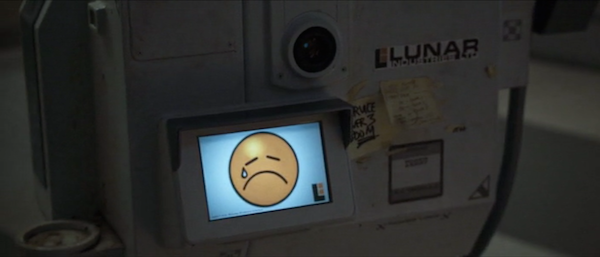

Following a short but effective interlude segment of slow motion cuts of a smiley faced and handmade countdown calendar and pictures of his wife, Sam bumps into "Gerty". His reaction of annoyance and slight anger is immediately apparent, as his human trait of walking away from the awkward scene, however later cuts reveal "Gerty" now cutting his hair and the two friends are chatting amiably again. We cut to a telling scene of Sam, still complaining of a headache, now building small model miniature figures, but this is also a bridge towards the end of the opening 10 minutes. Sam is alerted to an incoming message from home and again dressed casually in slacks and slippers runs to the computer terminal. Simple cuts between the computer screen and Sam depict his beautiful wife "Tess" (Dominique McElligott) and a now freshly showered and shaven Sam. A heart rending scene follows of Sam, desperate to return home waving to the computer screen, at both Tess and his daughter "Eve" (Rosie Shaw), ending the scene with his palm flat on the screen. Just before the message ends there's a glitch, a flicker of the screen, or was there? Sam is quizzical and unsure exactly what happened at the end of the message. Was it a glitch?

A virtuoso performance of greatness follows from Sam Rockwell. Real greatness. And it has to, otherwise we'd be dependent on a robotic machine! However, Kevin Spacey's voice for "Gerty" is interesting, in as much as it has a God like, spiritual and calming quality to it, as well as being able to react to Sam's questions as would a normal human friend. The containers used for the mining or harvesting are interestingly named Matthew, Mark, Luke and John, but the real key here is the overall spiritual, universal faith hinted at. Alone with his thoughts over a three year period with no human interaction has left Sam an emotional wreck, talking to himself and physically drained. Talking to his plants, making model villages, talking to himself, or to a robotic follower with a calming, soothing voice, even if he retreats to the outside he is surrounded by nothingness and a longing to return home. Hallucinations, visitations and flashbacks combine with Sam Rockwell's performance to provide an astonishing first time film from Duncan Jones.
The cream/grey/white of the interior of the space station reminded me of Space 1999. Now there's one for the teenagers! Similar in feel, but far superior to Steven Soderbergh's very good "Solaris" in 2002, there's also obvious parallels to 2001: A Space Odyssey, Alien, George Lucas' THX 1138 (a personal favourite) and (I'm told as I still need to watch for the first time), 1972's Silent Running. A fantastic film which I can't recommend highly enough.
Source Code (2011)

"I don't know who Sean is. And I don't know who you are"
Similar in many ways to Moon, subtly so as well, Source Code begins amidst crystal clear cinematography and really sharp swooping shots of a large city dominated by tall skyscrapers and office complexes. The slow moving overhead shots of the city are also brilliantly captured, and both of these themes continue throughout the opening titles and the entire film, of crystal clear, sharp cinematography, and great credit must therefore be paid immediately to Director of Photography Don Burgess. From these swooping aerial shots we dissolve into a train, and our lead character.
 Sean Fentress
(Jake Gyllenhaal) Manages to juggle this twisting narrative on board a train with a twist of dark humour lightly sprinkled with a dose of sarcasm. A great portrayal topped by a heart breaking telephone call home.
Sean Fentress is sleeping with his head resting against a train window and struggling to fully wake he is finally jolted awake by the train's blaring horn. Startled, disorientated and unable to fully focus on his surroundings, "Christina" (Michelle Monaghan) greets him with a compliment "I took your advice!" but Sean remains in a daze and unable to fully appreciate the gesture or again, his surroundings. He is jolted by every action within the compartment as if on high alert, the opening of a can of drink, the spilling of coffee on his shoe and a commuter complaining of the train's impending late arrival. His eyes now darting everywhere around the train compartment seemingly taking in every detail, every passenger, every interaction, yet still unable to fully focus on Christina or pay her any attention whatsoever "You're acting really strange this morning".


 "I don't know who you are. My name is Captain Colter Stevens. I fly helicopters for the US Army in Afghanistan". Christina laughs incredulously at her friend and constant travelling companion, but Sean leaves her and struggles in a daze along the train compartment, stumbling and unsteady on his feet. As the train reaches a Station, Sean watches every passenger disembarking, but in a daze and confusion as though trying to remember why he's doing this and for what purpose. Still confused he returns to Christina and following a brief overhead shot (one of many beautiful shots throughout the film) of the train travelling towards the city now named as Chicago, Sean is disturbed by the obscure reflections he briefly glimpses in the train windows. Disorientated he rushes to the nearest toilet to calm himself and following some deep breaths he looks into the toilet mirror to see a completely different reflection to himself! Checking his drivers license, he is definitely Sean! Or is he?

 Leaving the toilet he is immediately greeted by a worried Christina, however Sean is adamant he doesn't know who she is or indeed who Sean is. Before this can be explored any further a huge explosion rips apart the travelling train in a violent fireball. This opening scene lasts seven minutes and I hope this brief narrative has whetted your appetite for this incredible film! Any further exposition on my part would simply spoil a fantastic plot and brilliant story from Ben Ripley.
Supported by an excellent Michelle Monaghan as "Christina", who plays her role brilliantly with an ever present smile and playful tone, there are two further crucial supporting roles that whilst I can't fully appreciate for fear of providing spoilers, I can acknowledge briefly for their brilliant portrayals. Jeffrey Wright (The Ides of March, Quantum of Solace and brilliant in Syriana) plays "Dr Rutledge" with a ruthless efficiency but the star performance and portrayal of the entire film rests with Vera Farmiga as "Colleen Goodwin". Excellent in the recent Denzel Washington film "Safe House", Vera Farmiga brings the compassion and empathy needed to the film in spades.

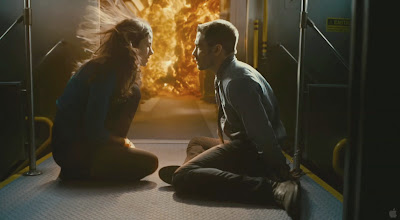
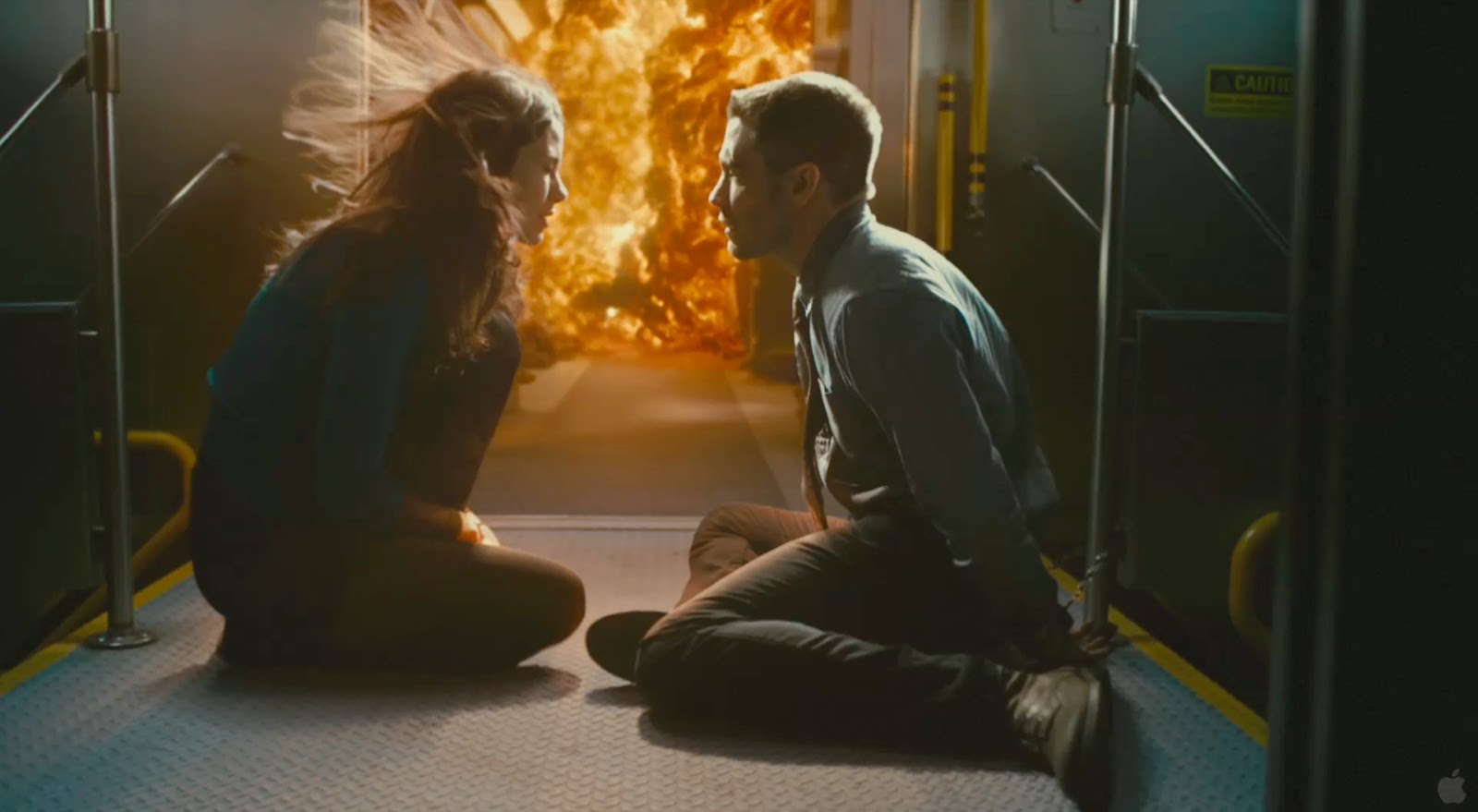
 There are many stand out scenes in this fantastic film, (the above slow motion impending fireball crash being one of them), interspersed as they are with terrific performances and numerous zoom mixed fades from the Director and superb editing from Paul Hirsch. A darkly funny film in places but a thriller at heart which challenges the audience to piece the puzzle together as we go. A looping story that may put off an audience seeking a more straight forward narrative, but please don't be put off by the challenge as when you go with the premise it truly pays off spectacularly. A story of love, compassion and of closure, it also raises the interesting question of what would you do to change your life or existence if you had the chance? If you had the foresight to be able to determine an outcome, would you try to change it or go with the pre-determined outcome?
Inspired by recent films such as The Matrix and definitely the recent Rian Johnson directed "Looper", this is a second triumph in a row for another inspirational, young British Director. Both of these creations are highly recommended!

Similar in many ways to Moon, subtly so as well, Source Code begins amidst crystal clear cinematography and really sharp swooping shots of a large city dominated by tall skyscrapers and office complexes. The slow moving overhead shots of the city are also brilliantly captured, and both of these themes continue throughout the opening titles and the entire film, of crystal clear, sharp cinematography, and great credit must therefore be paid immediately to Director of Photography Don Burgess. From these swooping aerial shots we dissolve into a train, and our lead character.

(Jake Gyllenhaal) Manages to juggle this twisting narrative on board a train with a twist of dark humour lightly sprinkled with a dose of sarcasm. A great portrayal topped by a heart breaking telephone call home.
Sean Fentress is sleeping with his head resting against a train window and struggling to fully wake he is finally jolted awake by the train's blaring horn. Startled, disorientated and unable to fully focus on his surroundings, "Christina" (Michelle Monaghan) greets him with a compliment "I took your advice!" but Sean remains in a daze and unable to fully appreciate the gesture or again, his surroundings. He is jolted by every action within the compartment as if on high alert, the opening of a can of drink, the spilling of coffee on his shoe and a commuter complaining of the train's impending late arrival. His eyes now darting everywhere around the train compartment seemingly taking in every detail, every passenger, every interaction, yet still unable to fully focus on Christina or pay her any attention whatsoever "You're acting really strange this morning".


Supported by an excellent Michelle Monaghan as "Christina", who plays her role brilliantly with an ever present smile and playful tone, there are two further crucial supporting roles that whilst I can't fully appreciate for fear of providing spoilers, I can acknowledge briefly for their brilliant portrayals. Jeffrey Wright (The Ides of March, Quantum of Solace and brilliant in Syriana) plays "Dr Rutledge" with a ruthless efficiency but the star performance and portrayal of the entire film rests with Vera Farmiga as "Colleen Goodwin". Excellent in the recent Denzel Washington film "Safe House", Vera Farmiga brings the compassion and empathy needed to the film in spades.


Inspired by recent films such as The Matrix and definitely the recent Rian Johnson directed "Looper", this is a second triumph in a row for another inspirational, young British Director. Both of these creations are highly recommended!
Warcraft: The Beginning (2016)


.jpg)


